
The Pittsburgh Pirates have been connected to numerous free agents in what is described as a different kind of offseason. General manager Ben Cherington is on record as saying he has more payroll flexibility this offseason than he’s ever had as Pirates GM. (According to my own estimate published on these pages previously, he has possibly $65 million in flexibility, minus what he spent to land Gregory Soto on Tuesday.) He went after the big fish in slugger Kyle Schwarber, offering a four-year deal for a reported $125 million. To the surprise of nobody who follows baseball, Schwarber returned to the Philadelphia Phillies on Tuesday. The Phillies retained him with a five-year, $150 million contract.
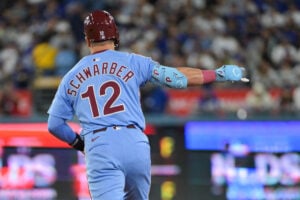
Given the Pirates’ track record, there’s skepticism among some baseball insiders, media, and fans about whether the Pirates were serious with their offer to Schwarber. The thought is that they’re making offers that they know won’t be accepted. It’s all a big PR stunt, say the naysayers, that is, whenever they’re not saying nay. Thus, we examine the burning question: Was it real or was it Memorex?
Pirates Connected to Free Agents: Real or Memorex?
Reliable sources such as Ken Rosenthal and Jon Heyman have connected the Pirates to virtually every free agent hitter from Ryan O’Hearn to Jorge Polanco to Eugenio Suárez, and even trade targets like Jo Adell, Brandon Lowe, and Ketel Marte. On something called The Inside Scoop, Rosenthal defended the Pirates against one of those skeptics, A.J. Pierzynski. “I had someone in the industry tell me yesterday, he thinks what the Pirates were doing with Schwarber was performative,” said Rosenthal. “But if you’re the Pittsburgh Pirates and you throw out a deal for $120 million, when you haven’t paid a free agent more than $39 million in your history. . . it’s certainly a deal that’s in the ballpark.” For Rosenthal, it’s a sign that the Pirates want to be a player in the free agent market.
“I had someone in the industry tell me yesterday, he thinks what the Pirates were doing with Schwarber was performative.”@Ken_Rosenthal on Pirates offer to Kyle Schwarber which ended up being a 4-year $125 million dollar offer. pic.twitter.com/5VP6ZLt5iz
— The Bucco Beat (@TheBuccoBeat) December 9, 2025
The Super Agent
One important voice who thinks the Pirates are serious in their pursuit of free agents is “super agent” Scott Boras. At the Winter Meetings on Tuesday, Boras spoke to a group of reporters. According to Colin Beazley of the Pittsburgh Post-Gazette, Boras said, “Ben and the Pirates have reached out to us on a number of players. They’ve made us very aware that they’re going to be active in the free-agent market, and they intend to add free-agent talent to the roster.”
Maybe, just maybe, Cherington can get something done with a Boras client. When Cherington was GM of the Boston Red Sox, he spoke to WEEI-FM in Boston about his relationship with Boras. “I think it’s good,” Cherington said. “I’ve worked with Scott on a lot of different things in the past. . . When you have a player in your organization who’s represented by Scott, when you’re trying to get something done with that player on the field or in conditioning in the offseason, he’s very helpful in those areas.”
The Super Pitcher
Enter reigning National League Cy Young Award winner Paul Skenes. He’s offered to lend a hand in recruiting free agents to the Pirates. The day he won the award, a report in NJ.com quoted an unnamed former teammate as saying that Skenes has been hoping for a trade to the New York Yankees. People close to Skenes said that’s nonsense. Skenes himself said his focus is on winning a World Series in Pittsburgh.
Skenes plans to sell free agents on his belief that the Pirates aren’t far away from being a contender. He’ll cite their strong, young pitching staff. Pittsburgh isn’t a bad place to live, either. It’s affordable – OK, maybe a free agent who signs a nine-figure contract won’t be concerned as much about that – and the people will generally leave a celebrity alone. So, there’s another important voice that believes in what Cherington is doing.
Your Attention, Please
We live in what author Jenny Odell has described as the “attention economy.” Cable TV news, talk radio, news sites, and social media are all competing for your attention. The way they get it and keep it is by feeding you items designed to keep you resentful, angry, and fearful. The noise keeps getting louder, and you keep coming back for more. Your favorite team stinks, and that means that somehow, you’re getting screwed. The only solution is to stay tuned in or logged on.
Growing up in Pittsburgh in the 1970s, I listened to a sports talk show hosted by Tom Bender on WTAE radio. Bender didn’t shout. He didn’t engage in the radio equivalent of clickbait. He was just a nice man who knew sports and gave fans a forum to discuss them. I called in many times during my formative years. His show would never survive in today’s toxic environment.
Pirates owner Bob Nutting may well be the most hated man in Pittsburgh. Thus, talk radio, social media, and even the newspapers feed Pittsburghers a steady diet of Nutting, Nutting, Nutting, and for dessert, more Nutting. Pirates fans feel he’s the cheapest owner in sports. Fans of other small-market teams in baseball feel the same way about their owner. But for the sake of discussion, let’s accept the premise that Nutting is the cheapest owner in sports.
The Offer to Schwarber
Now that I have your attention, let’s discuss what every first-year law student knows. To have a binding contract, five elements must be present:
- An offer must be made.
- The offer must be accepted.
- There must be consideration. In layman’s terms, each party must promise to give something or do something. If I agree to cut your grass and you agree to pay me $20, we have a contract. If I promise to cut your grass and you don’t promise me anything in exchange, we don’t have a contract, and you can’t sue me in court if I don’t cut your grass.
- The parties must be of legal age and have the mental capacity to understand what they’re doing.
- The contract must be legal. A contract to cut your grass is legal. A contract to kill your wife’s boyfriend isn’t.
(Disclaimer: None of this is meant to be legal advice. If you’re entering into a contract, consult an attorney, not a baseball article. Oh – and don’t contact me about cutting your grass.)
Obviously, the last three elements are present in any contract for a major league ballplayer’s services. Let’s take a closer look at the first two. The Pirates made an offer to a free agent, namely, Schwarber. If he accepted, the parties would have a contract. They need to formalize it and reduce it to writing, but they have a contract. It defies logic to think the cheapest owner in sports would take that chance with $125 million. After all, even though it seemed all along that he would return to Philadelphia, nobody can be 100 percent certain that Schwarber would have rejected Pittsburgh’s offer. It was for a higher average annual value than the one he accepted from the Phillies. As a left-handed hitter, he would have thrived aiming for PNC Park’s short right field.
As New York Yankees owner Hank Steinbrenner once said when Joe Torre rejected their offer to stay with the Yankees as their manager, “You don’t make an offer bluffing. What if he says yes?”
The Last Word
Does any of this mean that the Pirates will land any big-name free agents? Of course not. There’s a lot of competition for a few hitters, including competition from teams that have never been players in the market before. But the Pirates are making serious offers. In about three months, we’ll see whether that seriousness has paid off.
Main Photo Credit: Kim Klement Neitzel-USA TODAY Sports
The post Pirates “In On” Free Agents; Here’s the Reality About How Serious They Are appeared first on Last Word On Baseball.